

Agentic AI: The flight to the wrong Portland
Autonomy Is a Property of Context, Not of the Model

Everyone in your peer group is buying autonomous AI agents this year. The demos are good. The slides are confident. The bottleneck is none of the things on those slides.
It is not the model. It never was.
The bottleneck is the unglamorous work of taking what your organization knows and writing it down in a form a machine can read. Most of that knowledge has never been written down at all. That is the whole problem, and almost nobody has budgeted for it.
The flight to the wrong Portland
Picture the canonical demo. You tell the agent: “Book my flight to Portland for the client meeting tomorrow.” A chatbot would ask you a question. An autonomous agent acts.
So it books Portland, Maine. Your client sits in Portland, Oregon. The agent did not fail because the model was weak. It failed because it never knew the client is in Oregon, which travel vendors are approved, or where you are flying from. None of that lives in the model. It lives in your organization.
With a chatbot, a human catches the mistake before it costs anything. With an autonomous agent, the mistake is executed, paid for, and waiting at the wrong gate. The model was confident. It was confidently wrong.
A language model is stateless by design. It knows language. It does not know your workflows, your approval chains, or your operational reality. That gap is not a model problem you can buy your way out of. It is a context problem you have to build your way out of.
This is the part the market gets backwards. The industry sells autonomy as a property of the model: better LLM, more autonomy. The honest version is the opposite. A weaker model with clean context beats the best model with none. Autonomy is earned through context. It is not shipped in a release.
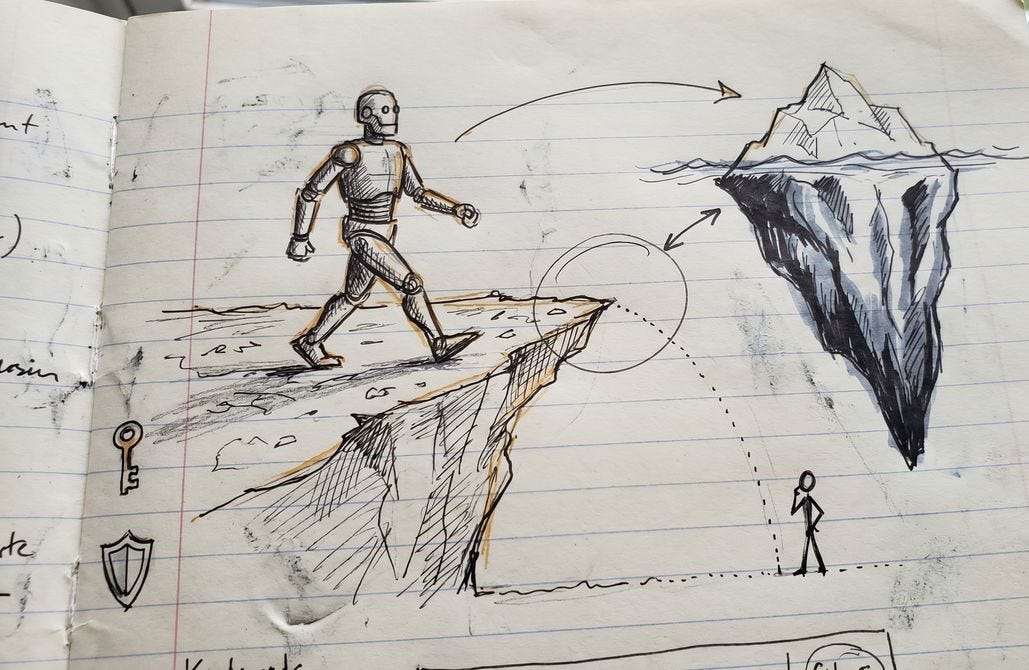
The dark matter problem
Here is the uncomfortable part. The most valuable knowledge in your organization is not in any system. It is in people’s heads, in corridor conversations, in the unwritten rule that everyone follows and nobody documented.
Call it the dark matter of your organization. You cannot see it, but it holds everything together.
Turning that into machine-readable context is real work. Someone has to sit with your experts, watch how they actually decide, and translate undocumented judgment into something explicit. This is the work nobody wants to do, because it is slow, expensive, and impossible to delegate to a tool. It is also the work that decides whether autonomy is real or theatre.
And there is a problem underneath the problem. You are asking people to write down the very knowledge that makes them feel indispensable. Then you pretend this is a data exercise. It is not. It is the scar at the center of the whole effort, and treating it as a tooling question is how these projects quietly die.
There is nothing off the shelf
You cannot buy a finished context layer. The market is immature, the tools are fragmented, and the mature vendor product does not exist yet. Anyone who tells you otherwise is selling the slide, not the system.
For a large public-sector organization in Germany, in a heavily regulated environment, that turns out to be a feature. The codified knowledge stays in the building. It becomes a sovereign asset you own, not a dependency you rent. Digital sovereignty here is concrete: your context does not stop working because a vendor changed its terms, and your decision logic is not sitting on someone else’s roadmap.
I use international AI models extensively, for learning, prototyping, and strategic evaluation. For regulated data and operational casework, they are off the table. Knowing where to draw that line is the actual leadership skill, not a footnote to it.
What I would do before the next pilot
After four decades in regulated environments, I have watched enough automation projects fail at exactly this point to stop blaming the technology. Before you approve the next agent pilot, put the money into context, not models.
**Name the owners.** Every domain needs a named context owner plus one central curating function. Release through a defined four-eyes procedure, not ad hoc. Knowledge with no owner becomes a silo again.
Fix the incentive. Frame codifying knowledge as a promotion, not a self-erasure. The person who writes down the context becomes the authority over the system, not its replacement. Tacit knowledge is never fully recoverable anyway. The human stays the final decision-maker. Say that out loud and mean it.
Curate one source, not many copies. One concept, one governed definition, versioned, reviewed. Redundancy is how contradictions creep back in.
Protect integrity like security code. Versioning, signatures, audit trails, role-based write access, four-eyes release. Context poisoning is real: feed an agent a false rule and it will execute it with full confidence. Validate dynamic inputs before the agent treats them as truth.
Design for graceful failure. Where the codified context ends, the human takes over on purpose, not by accident.
The agents are coming, and they will do plenty of things better. They will do nothing better for an organization that has never written down what it actually knows. The model is not the hard part. The model was never the hard part.
What is the one piece of knowledge in your organization that lives entirely in one person’s head? Hit reply and tell me. I read every response.