

Context Is Your Next Critical Infrastructure
Your AI needs context, not more tools.

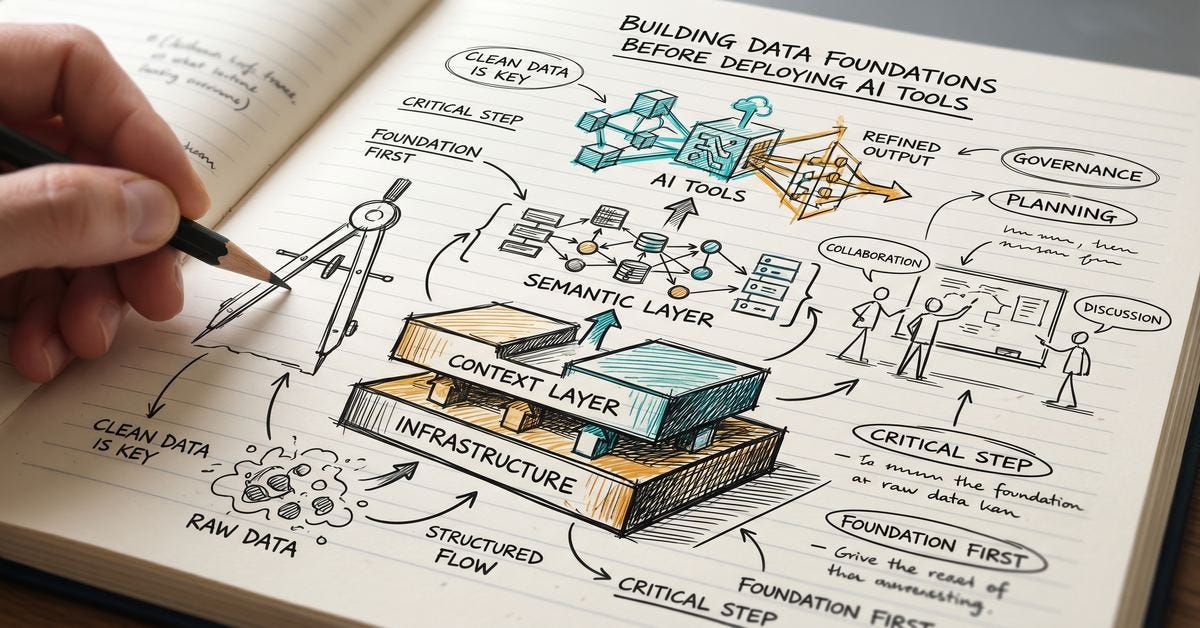
I recently came across a striking number: organizations that report the highest satisfaction with their AI outcomes spend four times more on foundations than on tools. Not twice. Four times. As a percentage of revenue, they pour money into data quality, governance structures, and people — not into platform licenses.
This stopped me. Because in most strategy conversations I witness, the budget discussion starts with: Which tool should we buy? Not: Is our data in a state that any tool could actually work with?
The Real Bottleneck
Here is what I have learned from decades in a highly regulated government environment: the bottleneck is never the model. The bottleneck is context.
A structured context layer — semantic mappings, ontologies, machine-readable rules — reduces the computational cost of reasoning models by a factor of two to three. Same accuracy. Lower cost. Context is simultaneously a quality lever and an efficiency lever. Yet almost no one treats it as infrastructure.
In my domain, this is not optional. Without semantic labeling of individual data points, analysis is constitutionally prohibited. No labeling, no analysis. Full stop. This is not a bureaucratic inconvenience. It is a design constraint that determines everything else.
But here is the transferable insight: every organization working with sensitive data faces the same fundamental question. Do you invest in the tool, or in the foundation the tool needs to stand on?
The Cautious Paradox
There is a popular framework that classifies organizations as AI-first, AI-opportunistic, or AI-cautious — and then declares the cautious position a high-risk one by 2030.
I disagree. Or rather: I think the classification is too blunt.
The real dividing line runs between cautious-without-foundation and cautious-with-foundation. An organization that deliberately delays tool deployment while building its context layer, governance architecture, and semantic infrastructure is not at risk. It is preparing.
An organization that is cautious AND idle — that is a different story entirely.
Caution without preparation is paralysis. Caution with preparation is strategy.
Three Things Worth Doing Now
Run a context audit. Take your last AI initiative. Ask: what percentage of project time went into data preparation? If the answer is above 60 percent, you are missing the context layer.
Declare context as infrastructure. Knowledge graphs, semantic layers, policy-as-code — these deserve the same project status as network infrastructure. With dedicated budget, governance, and a board-level sponsor.
Redefine stewardship. The role of data stewards is shifting from reactive compliance to strategic refereeing. Quality, reusability, and governance effectiveness need clear ownership at leadership level.
A Question for You
I am curious: does your organization distinguish between being cautious and being unprepared? Or does the strategy conversation collapse both into the same bucket?
Hit reply. I read every response.
— Andreas