

The Skipped Floor: Why Your Workforce Gets AI Training and Your Leadership Doesn’t
Left alone with the harder half of AI-Training for Leadership

The organization rolls out AI training. The workforce shows up. The completion numbers look good. And the most expensive competence gap in the building sits untouched, one floor higher. Why do we train everyone except the level that decides on risk, money, and people?
A working knowledge of AI is not optional for those who carry it. Roughly one in five executives is considered genuinely AI savvy. A large majority privately admit they overstate how much they understand. Nobody says it out loud, because a knowledge gap at the top reads like an admission of weakness. That silence is the real finding. Not that the workforce knows too little. That leadership was left alone with the harder half.
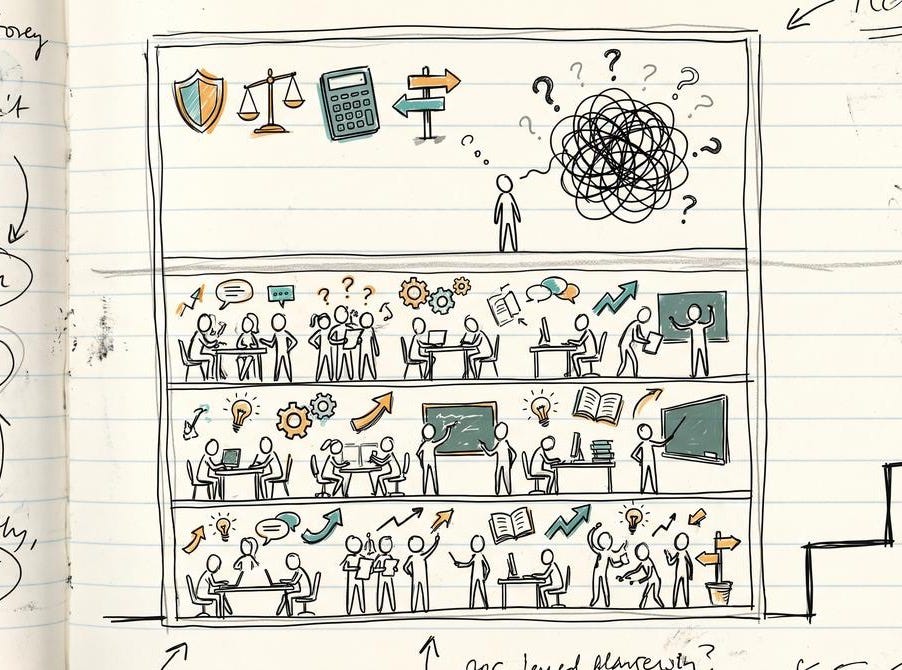
The comforting reflex
There is a reflex that sounds right and points the wrong way. It says: leaders must model AI, so they should use the tools themselves. Half true. Personal tool use is pleasant, but it is not the competence that matters.
An executive does not need to train a model. An executive needs to judge whether a project is sound. That is a different class of knowledge. Operating a chat assistant fluently tells you nothing about whether a high-risk system is even permissible under the law, what it costs to run over five years, or how you would recognize that the rollout succeeded. The operation is visible. The judgment is what counts.
Why does standard training miss the top? Because it is built for the broad base. Paths to senior leadership never required data or AI knowledge. People who rose needed budgets, law, people, negotiation. AI was not a prerequisite. So today the employee curriculum gets passed upward, the same basics, the same click-throughs. It misses leadership because leadership decides elsewhere. The workforce applies AI. Leadership answers for what happens with it at scale. Those are not the same learning objective.
There is also a quiet incentive to leave the gap open. Training for the base produces attendance rates, and rates can be reported. An honest format for leaders produces something else first: the realization of how much the room does not yet know. Nobody enjoys reporting that upward. So the comfortable version wins, and the uncomfortable, more important one waits for later. Later rarely comes.
The harder half
What should leadership be able to do instead? The judgment splits across four domains, and none of them can be delegated to IT.
Protect. Governance, law, ethics. Which regulatory frameworks apply, what triggers a high-risk classification, where the line runs between permitted and forbidden. In a regulated or public context this is not a bonus. Human final say is non-negotiable, and anyone who cannot judge that signs blind.
Prioritize. Value, economics, vendor choice. How do you measure whether an AI rollout succeeded? Not in minutes saved, but in an outcome you can tie to the goals of the organization. And what does the whole thing cost over time, not in the pilot year? Miss the full cost structure and you mistake a cheap entry for a cheap solution.
Prepare. Workforce, roles, human-AI collaboration. Which role changes, which stays, who carries which context knowledge from here on. The most thankless task, because it is never finished.
Position. Strategy, differentiation, business model. Where AI shifts the rules, and what that means for you.
Serve only one domain and you make half decisions. The dangerous part: half decisions feel like whole ones, until someone demands the missing half.
A concrete case
A large organization in a heavily regulated environment took AI training seriously. It rolled out e-learning: foundational AI knowledge for everyone, plus specific courses on using individual tools. Done well. Well received. The participation figures were presentable.
And still the decisive part was missing. For the leadership level there were no targeted measures on the topics only leaders can own. AI governance. The requirements of European AI law for high-risk systems. Criteria for when an AI rollout counts as successful. The long-term cost trajectory and the question of where, given good domain context, costs can actually be reduced. And policy as code, the practice of turning rules into something a machine enforces, rather than a PDF nobody reads.
The pattern is uncomfortably symmetric. The workforce was enabled to use AI. Leadership was left alone with the question of whether and how to be accountable for it. The easy half was trained. The hard half was skipped. Not out of neglect, but because the hard half is not a finished module you can buy and deploy.
Sequence beats speed
There is a second mistake, and it tempts more than the first. It is called skipping ahead. An organization declares itself AI-first, and leadership wants to start with the big themes right away. Agentic systems, business-model reinvention, the frontier. Ambitious. Usually premature. Because a stated ambition is not the actual maturity of your leadership. One describes where you want to be. The other, where you stand.
A sensible order has three stages, and it does not shortcut. First the non-negotiable minimum: recognize risk, use the tools as a spark for curiosity, nothing more. Then the balancing act between control and value: from risk-only oversight to structured experiments that weigh effort against benefit. Only then the frontier, with advanced concepts and decisions under real uncertainty. Jump to stage three without an honest starting point, and you overwhelm leadership and call it incompetence, when only the sequence was wrong.
So the opening question is not how far do we want to go. It is: where do we actually stand? And the answer comes not from the mission statement but from a sober look at your own room. Is AI discussed precisely, or as a catch-all? Are risks named or smiled away? Can anyone connect a use case to a business outcome?
You can train the workforce as thoroughly as you like. It does not replace the judgment at the top. The easy half can be bought. The hard half you have to learn yourself.
I also write in-depth analysis in German on my blog: https://www.lezgus.de